Unweaving the Rainbow - Marcin Janusz
April 5 , 2026 – June 5, 2026
April 5 , 2026 – June 5, 2026
There was an awful rainbow once in heaven:
We know her woof, her texture; she is given
In the dull catalogue of common things.
— John Keats, Lamia (1820)
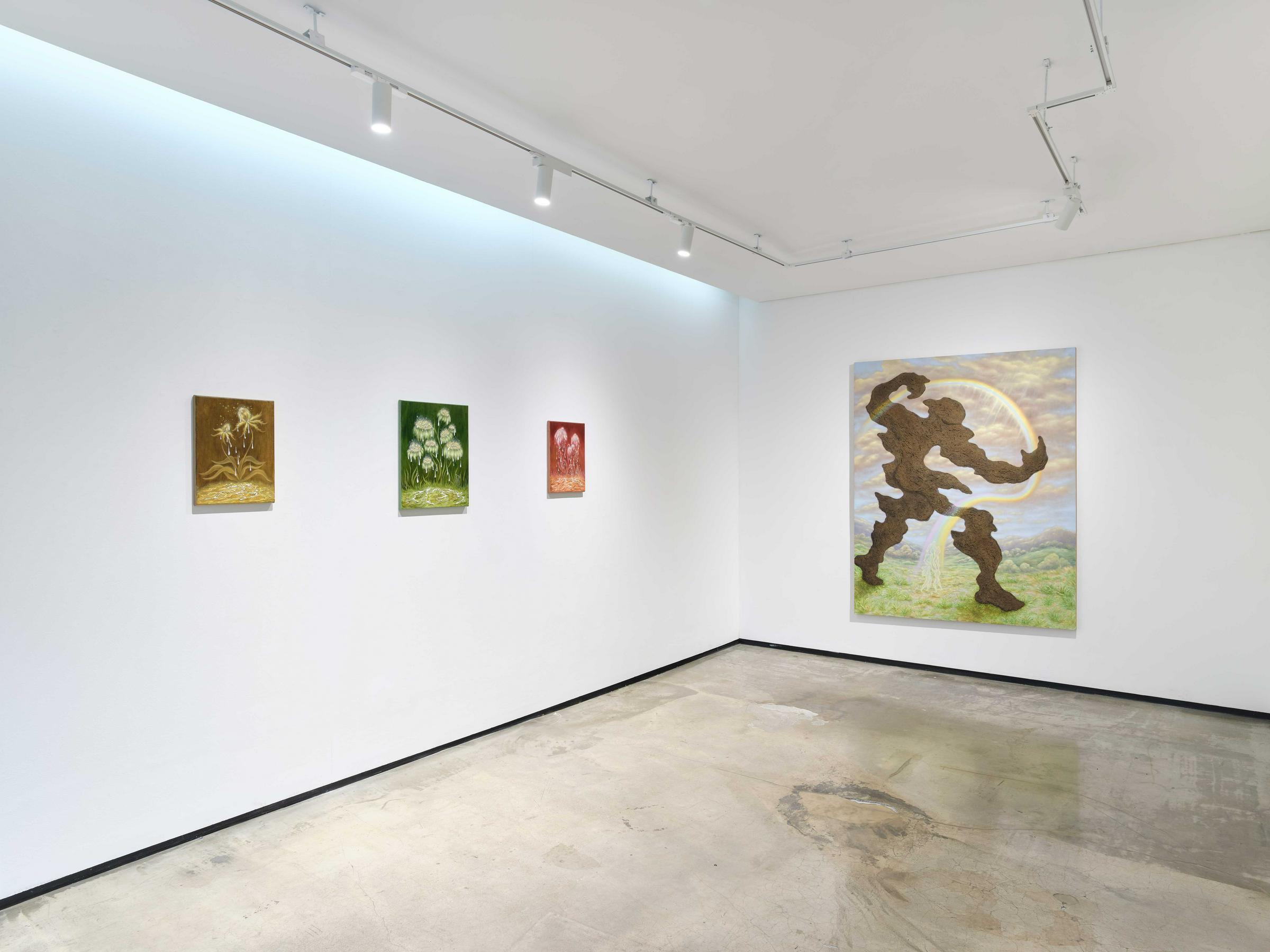
In 1820, John Keats accused Isaac Newton of destroying the poetry of the rainbow by reducing it to a prism’s trick. Two centuries on, the quarrel persists in subtler forms: must understanding always come at the cost of wonder? Marcin Janusz, a Polish painter who studied medicine before turning to art, has spent his practice refusing to choose. His canvases do not illustrate a position in this old argument. They stage the collision itself.
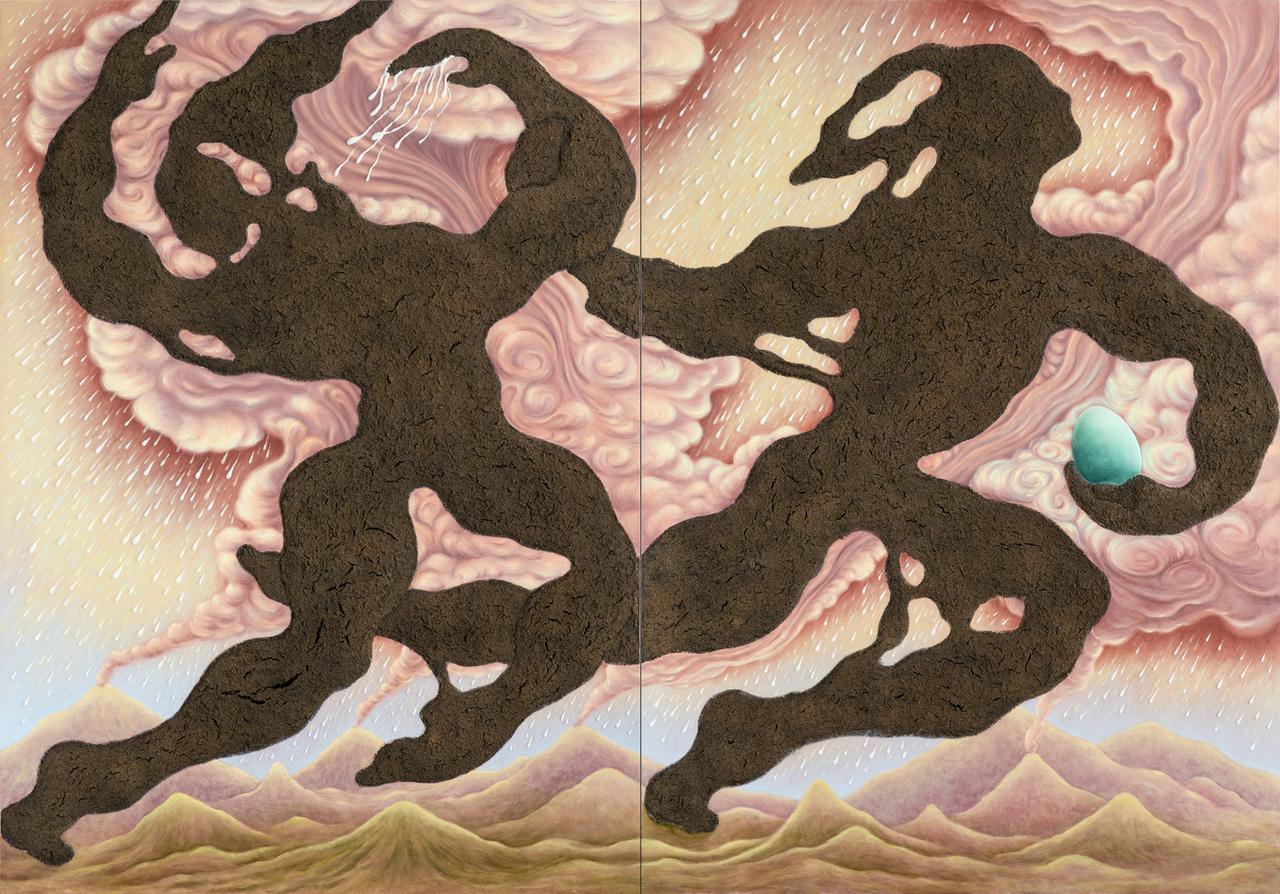
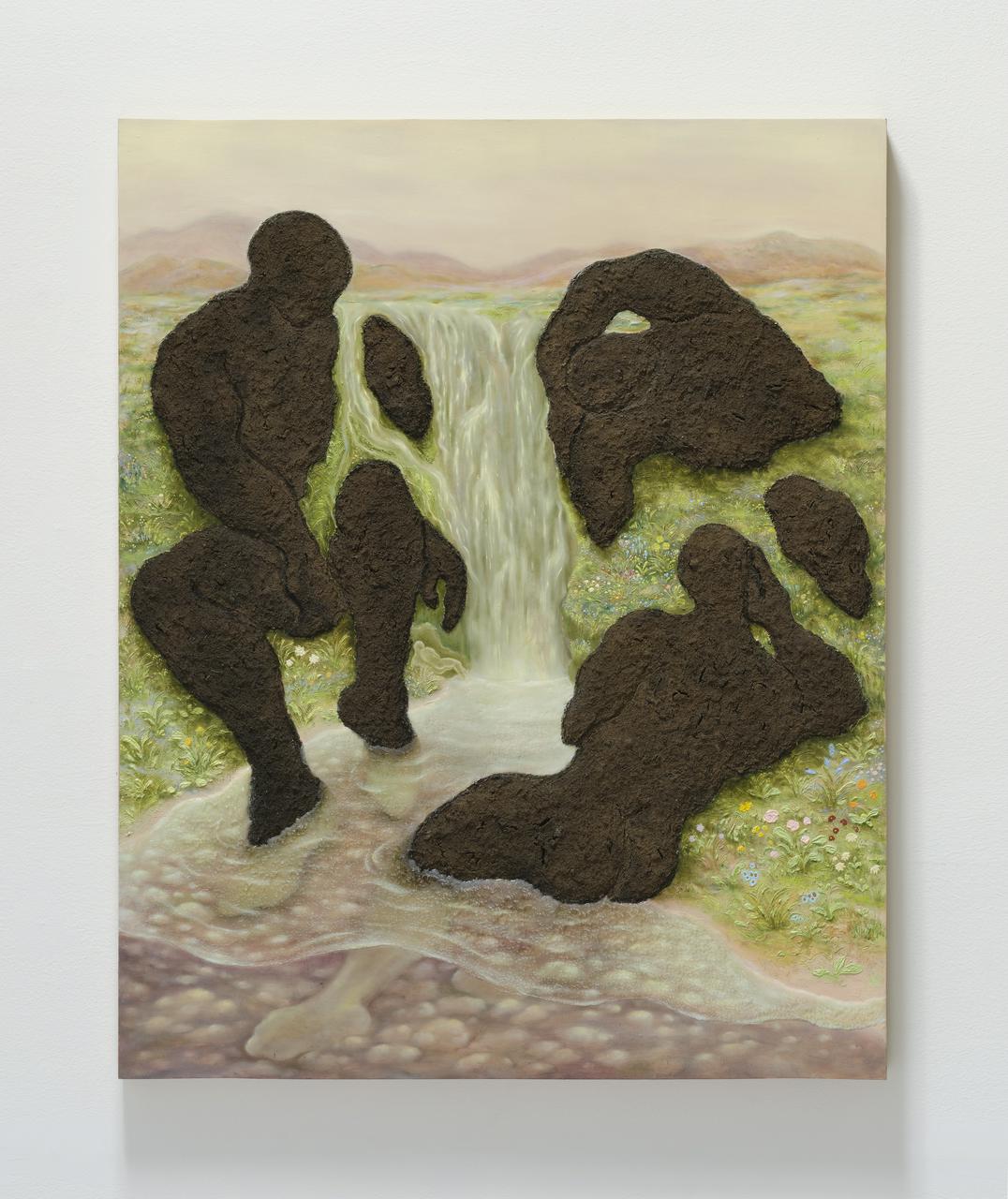
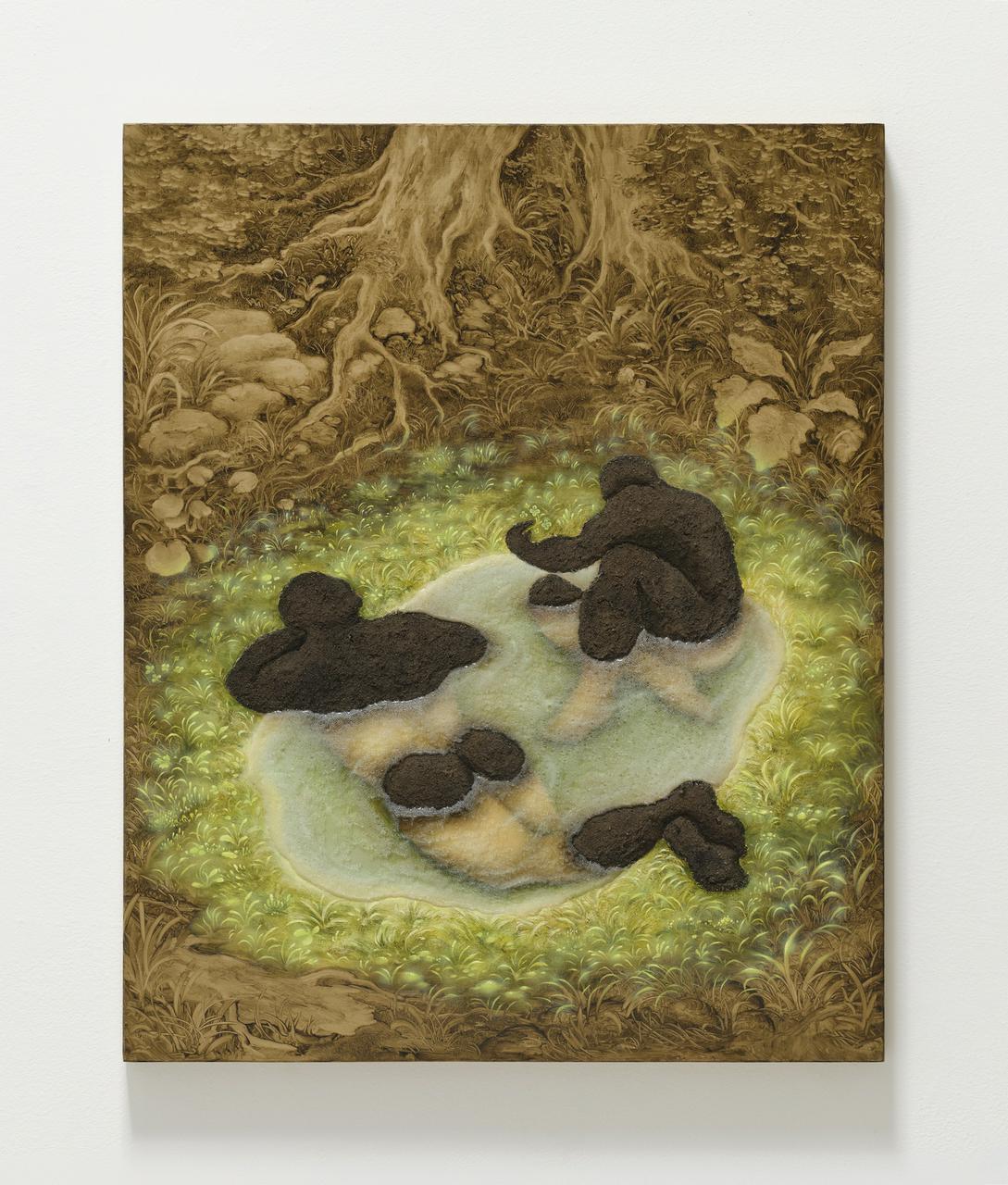
The works in Unweaving the Rainbow, Janusz’s first solo exhibition in Seoul, presented at Lazy Mike, are built from oil paint, soil, sugar, and resin applied to plywood and canvas: materials whose behavior upstages what they depict. A figure rendered in earth rises from a painted meadow. Crystallized sugar weeps from luminous petals; drops of milk and sugar harden into opaque beads across a painted field; transparent resin pools inside a frame of dried mud, trapping air bubbles and a floating body. Soil carries what has decomposed into it. Sugar crystallizes only by surrendering its moisture. Resin seals whatever it touches between preservation and suffocation. The logic is closer to volcanism than to painting — forces that cannot be fully governed, reshaping the ground they emerge from. Where conventional painting keeps its medium invisible, pigment in service of illusion, Janusz forces it forward, so that every surface becomes a contest between what is depicted and what simply is.
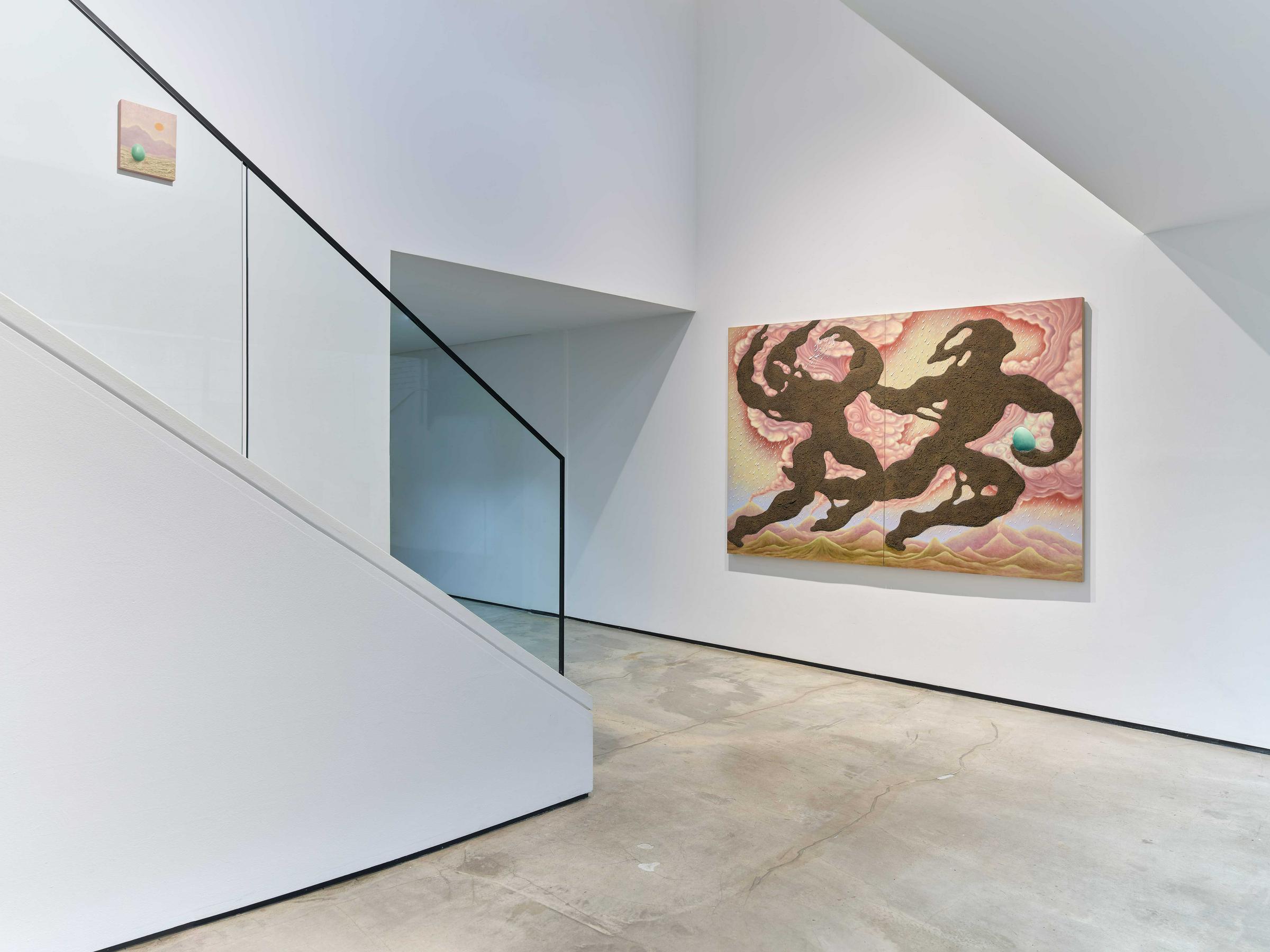
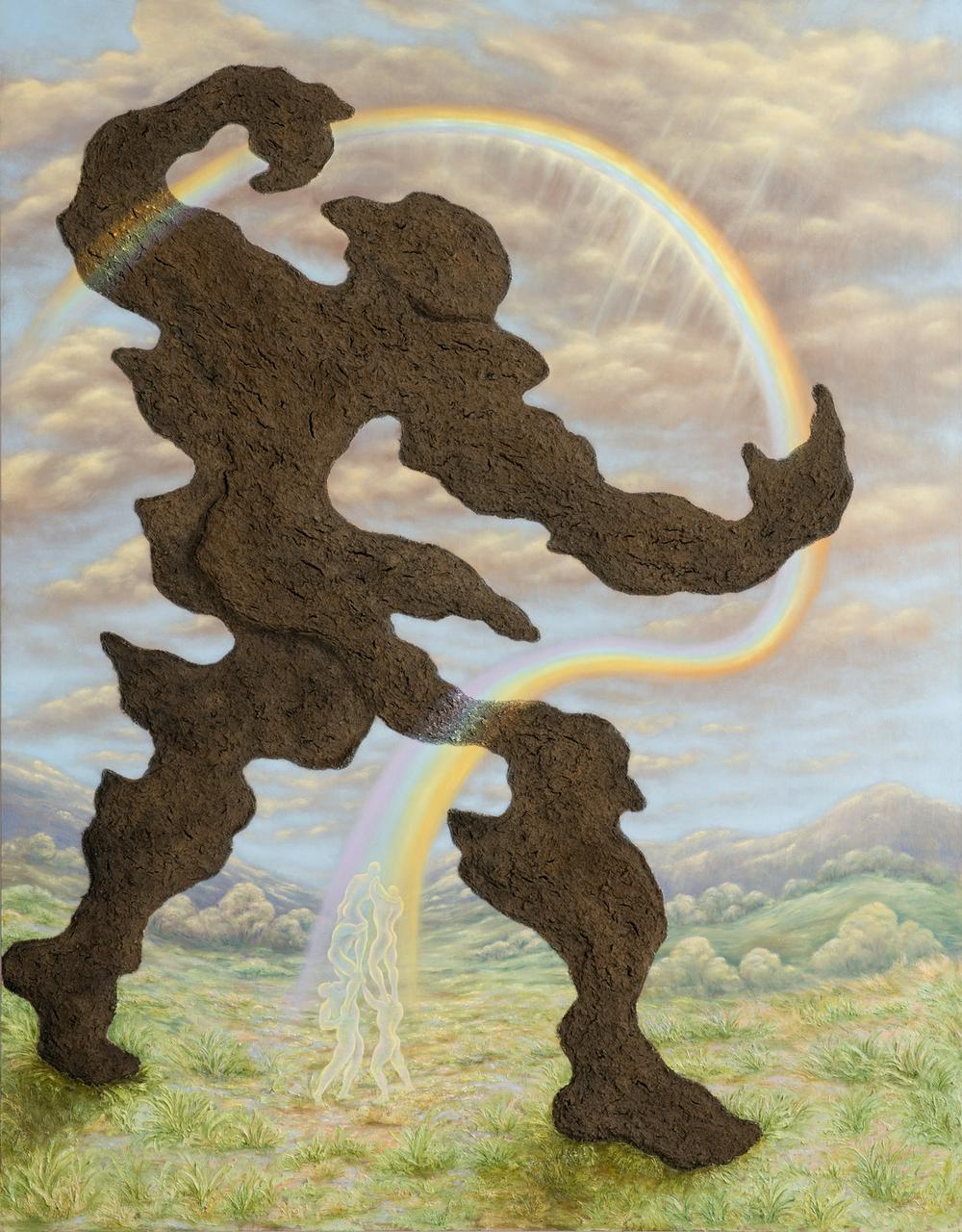
The British novelist J.G. Ballard spent the 1960s imagining planetary disasters: flood, drought, crystallization. The characters in Ballard’s disaster trilogy experience these not as catastrophe but as transfiguration. In The Crystal World (1966), a forest begins to crystallize: trees, rivers, animals slowly encased in crystal; those who witness it are drawn toward it, not away. Something of that transfiguration is at work in Janusz’s largest canvas, The Giant Tearing the Rainbow Apart, where an enormous figure made of soil rips through a painted arc. One could read the giant as a destroyer, except that the figure is not invading the landscape but produced by it — the ground remaking itself through its own undoing.
One might be tempted to see Janusz’s soil and sugar as eccentric departures from the oil-on-canvas norm. The assumption is historically backwards. Prussian Blue appeared only in 1704. Before that, for roughly forty thousand years, every pigment was organic: ochre, calcium from bone, lapis lazuli ground to ultramarine. To paint was to handle matter that had once been alive or had never stopped being geological. Korean traditional painting operated on precisely this principle: iron-oxide red, malachite green, calcium white ground from oyster shells, earth and animal rendered into color. Synthetic chemistry broke that continuity so thoroughly that we forgot it was ever continuous. In Seoul, a viewer versed in Korean material traditions may recognize something unexpected in Janusz’s earth-built figures: not a foreign practice, but a kinship obscured by the very modernity both traditions now inhabit.
Kinship, though, is not the same as comfort. And there is comfort here — or what presents itself as comfort. Something folk, something pre-modern, returning through the painted surface. The muted palette reinforces it: hazy purples, soft earthy greens, an orange sun that looks remembered rather than observed. The work does not resist a nostalgic reading; it invites one. But the paradise it conjures is not stable. Its soil is fed by decomposition; its sweetness is sugar already hardening. Why does soil on plywood feel like a homecoming? Perhaps because painting made with industrialized materials has estranged us so completely from what painting once was that encountering it again registers not as knowledge but as longing — for a continuity we can name but no longer practice.
The works divide loosely into three groups. Large rectangular canvases where earthen figures inhabit painted landscapes; these are the most narrative. Oval compositions framed entirely in soil, where the earth becomes the border and the image appears to open downward into the ground. Quieter, more intimate, less interested in story than in texture. And a series of paintings titled Magic Flowers with Sugar Tears, where crystallized sugar replaces earth and the imagery drifts toward the Slavic fern flower, a blossom absent from botany yet persistent in folklore. Each format changes what the material can do: narrate, enclose, or dissolve.
One small painting, barely larger than a hand, strips the exhibition back to a single image: a green egg sitting on a field of earth, an orange sun above distant mountains. There is nothing else: no giant, no meadow teeming with figures. Just the egg, the ground, and whatever is waiting inside. The mythologist Mircea Eliade saw the cosmogonic egg — a motif found across cultures, in which all existence is compressed into a single shell — as totality that must crack for time to begin; Janusz’s egg sits before that moment, neither promising nor refusing. It simply sits. Across all groups, forms refuse to settle. They drip, crumble, harden. A figure may be giant or infant, root or limb, soil or flesh. The painted illusion and the physical substance share the same surface but never fully merge.
Janusz has described his interest as attention to “the moment when these two orders begin to intertwine.” His paintings hold that moment open. They do not settle the quarrel between Newton and Keats; they give it a body — one made of soil, sugar, and resin, caught in circulation rather than suspension. Death feeds the soil; the soil produces forms already decomposing. Janusz’s figures resemble the mandrake of folklore — creatures that spring from the seed of the dead. Nothing is lost, and what rises is never separable from what has gone into the ground.
Keats feared that philosophy would unweave a rainbow. Janusz lets the unweaving happen. What the loosened threads become is another question, one the paintings leave open.
- Jaeyong Park (Independant Curator)